The
song is bittersweet, about love found and lost, and the memories that remain.
All that is left after years and years is the laughter they shared. And it
comforts them.
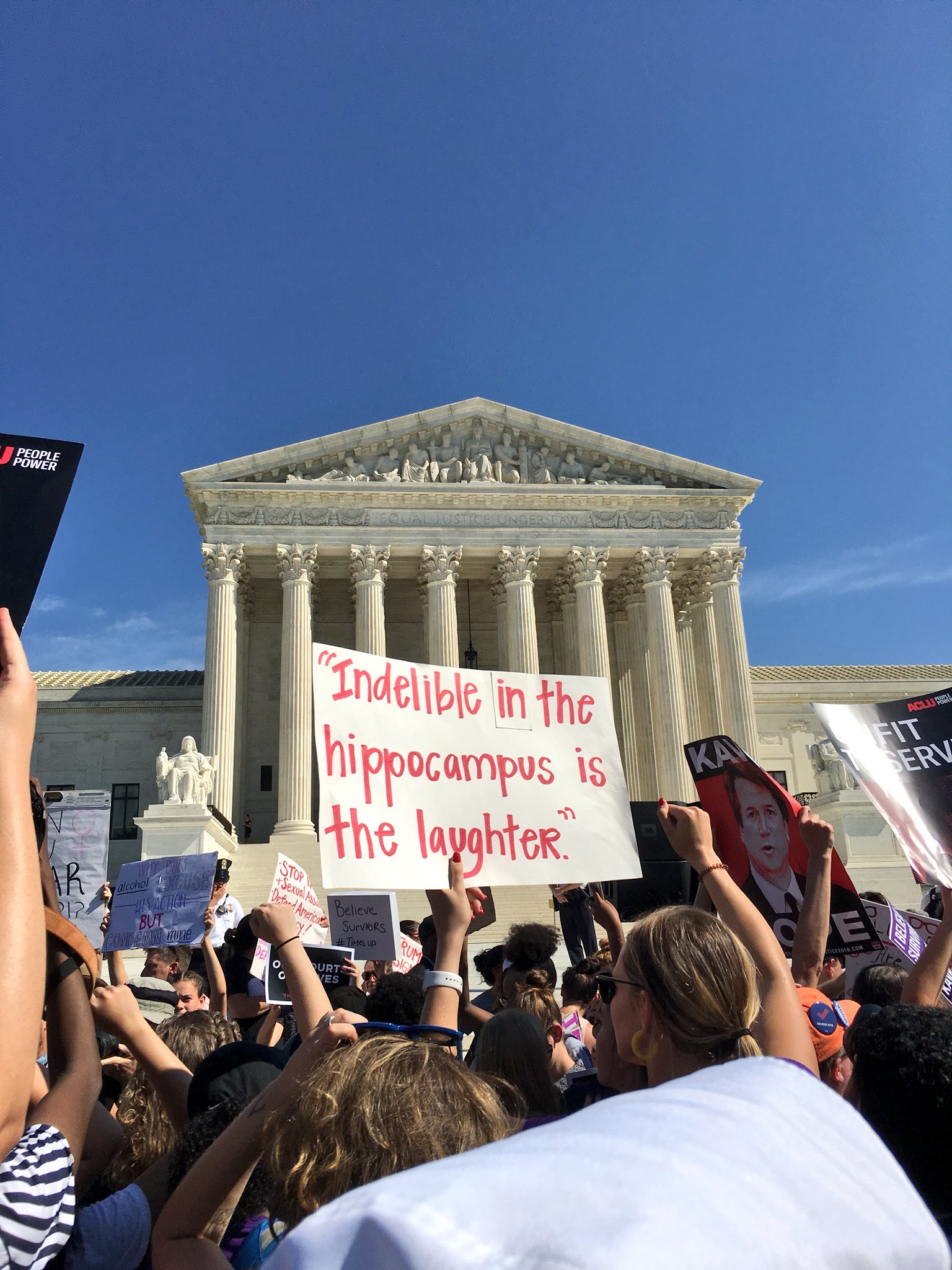 |
| From the ACLU's Twitter Feed, October 4, 2018 |
Yes,
laughter is what we remember. A universal communication, it may actually have served
as language for primitive man. Not to indicate humor, but to show mutual
harmlessness, openness, and friendliness. Babies laugh before they speak, not
because anything is funny. Instinctively a baby knows that laughter helps two
brains sync together, and hopefully that other brain belongs to someone who is
going to care for him, bond with him, protect him. It stimulates endorphins and
oxytocin, creating what we call love. Love that grew from laughter.
It is biology,
evolution, magic — a precious gift shared by only a few other species on earth.
But
laughter has a dark side. There is laughter that is not meant to show
friendliness or bonding. It is meant to demean, belittle, and objectify. Those
who use laughter as a weapon are often very skilled at it — the bully who makes
someone cry, then convinces the rest of the kids to laugh. The sociopath who
laughs when inflicting pain. Whether consciously our unconsciously, the person
using laughter as a weapon knows that that laughter not only causes pain in the
moment, but repeated pain, time and again. For some victims, they can no longer
tolerate hearing laughter, even when it is joyous. Others are so traumatized
they are convince that they do not deserve to laugh.
I
know that feeling. Laughter was used as a weapon against me more than once in
my life. There were the mean girls who didn’t let me into their group when we
moved from New York to New Jersey. They laughed at my clothes, they laughed at
my accent. Laughter that I could hear sitting inside my house, watching them
walk by, sure that they knew about the chaos I was living with.
I
carry other laughter with me. The laughter that came with the nickname “The
Brainless Wonder.” The laughter that came when, after being forced to sing into a
tape recorder (you like to sing? Then sing!), a song that had lyrics something
like “until I die…” For what seemed like years I had to listen to that tape,
and the voice that cut me off — “with a voice like that, you’re dead already!”
I
was easily embarrassed, felt self conscious, and overly sensitive to laughter
for most of my school years. Someone threw a firecracker at my feet in a school
hallway, and the noise momentarily deafened me. But I could see the laughter on
the face of the person who threw it.
It
was music that saved me, and a music teacher who tolerated my hypersensitivity
and tendency to storm out of a room and slam the door. I found the courage to
sing again, and I spent my entire senior year studying humor and
satire. The pain of the harmful laughter began to fade — not completely, it will never be
completely gone, but it was locked away.
I
thought it was locked away for good. But the brain is capricious with memory.
Things will happen that launch you right back to the most uncomfortable moments
of your past.
Such
is what happened to me listening to the testimony of Dr. Ford. Like many, I had
been sexually assaulted as a teen. A family friend cornered me in a boathouse,
groped me, pulled me close, and put his hands inside my bathing suit. He laughed loudly as I broke
free and ran away. I had actually forgotten about that laughter until Dr. Ford
talked about her own experience. The fact that laughter burns into the
amygdala. That laughter remains a sharp memory when other details may become
fuzzy. I found out that laughter, used as a weapon, lies in waiting, ready to
come roaring back to your conscious mind when you experience just the right
situation.
And this evening, I witnessed the president
of the United States mock Dr. Ford’s testimony, in the same way he had mocked
the physical challenges of NY Times reporter, Serge Kovaleski. It made me sick.
It made me furious. It made me ashamed because now that my memories were
flooding back to me, I realized that society had permitted the mocking of Mr.
Kovaleski, and would now permit the mocking of Dr. Ford.
There will be a
flurry of outrage, but nothing will be done. What CAN be done? The man seems
made of Teflon – he can sit in a fire of his own making and not get burned.
Laughter has
become a mission in my life. I know its importance and power. Laughter can
heal, bond enemies, reduce pain and lighten depression. Laughter can highlight social ills and
announce to the crowd that the emperor has no clothes. But, in the hands of a
bully, a person of power, or an entire society, laughter as a weapon can cause
unrelenting trauma.
Tonight I feel
that my voice of laughter’s joys and benefits is weak and unheard. I feel
complicit in not doing something, anything to stop this.
But I have no
answers. It is the laughter I remember.


